

Now Reading: Is the Shiseido Ultimate Sun Protector Lotion Worth the Hype? I Found Out
-
01
Is the Shiseido Ultimate Sun Protector Lotion Worth the Hype? I Found Out

This post may contain affiliate links. Please read our full disclosure here.
Brand: Shiseido
Format: Lotion
Activity & Use Case: Daily Face Wear, Body Sunscreen, Sports & Outdoor Use
Filter Type: Chemical
SPF Level & Broad Spectrum: SPF 60+, Broad-Spectrum Protection
Active Ingredients: Avobenzone 2.3%, Homosalate 10%, Octisalate 5%, Octocrylene 5%
Fragrance: Synthetic Scent
Water Resistance: 80 min
Special Features: SynchroShieldRepair™ Technology, WetForce, HeatForce, Oxybenzone- and Octinoxate-free
Price: Around $26 for 50 mL, $52 for 150 mL, and approximately $94–$96 for 300 mL in the U.S.
I’ll admit it: when a sunscreen is repeatedly described as a luxury holy grail, I go in with a little skepticism. Shiseido Ultimate Sun Protector Lotion SPF 60+ has the kind of reputation that makes expectations sky-high, so I wanted to know whether its real appeal comes from the fancy name and premium price or from a formula that genuinely makes sunscreen easier to wear every day.
My skin is combination, mildly dehydrated, and occasionally acne-prone, with a T-zone that gets shiny in hot weather while my cheeks can feel tight. I also tend to notice fragrance and eye sting quickly, so I’m not the easiest person to impress with sunscreen. What interested me most here was the combination of high SPF, strong water resistance, and a texture designed to disappear rather than sit heavily on the skin.
The Quick Verdict
Overall Rating: 8.1/10
Best For: Daily and outdoor sunscreen users who want high SPF protection, a lightweight clear finish, and strong resistance to heat, sweat, and water.
Skip This If: You have very sensitive eyes or fragrance-sensitive skin, prefer a completely matte finish, or want an inexpensive sunscreen.
Packaging & Design
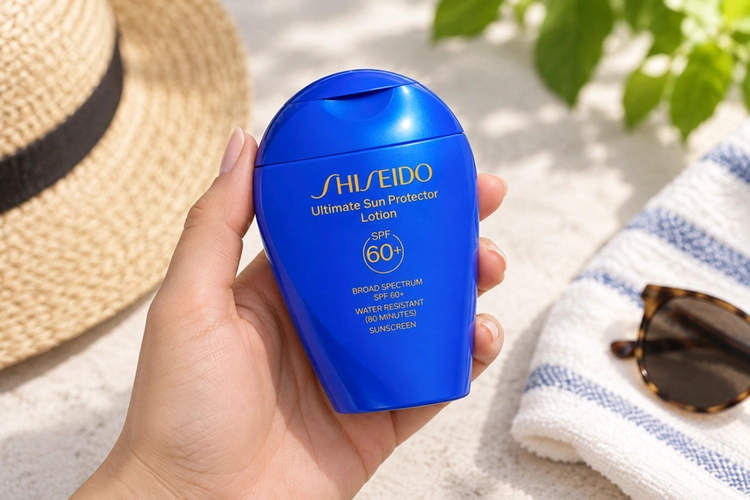
The bottle has a polished, distinctly premium look. It is an opaque blue, squeezable bottle with a narrow dispensing nozzle, which suits the very fluid consistency of the lotion and gives me much more control than I would get from a wide-mouthed bottle.
There is one important step I had to remember every single time: shake it well before using it. The formula is a biphasic liquid, so agitation helps redistribute the sunscreen filters and other components before dispensing. It is not difficult, but skipping that step is something I would rather not risk with a product whose protection depends on an even film.
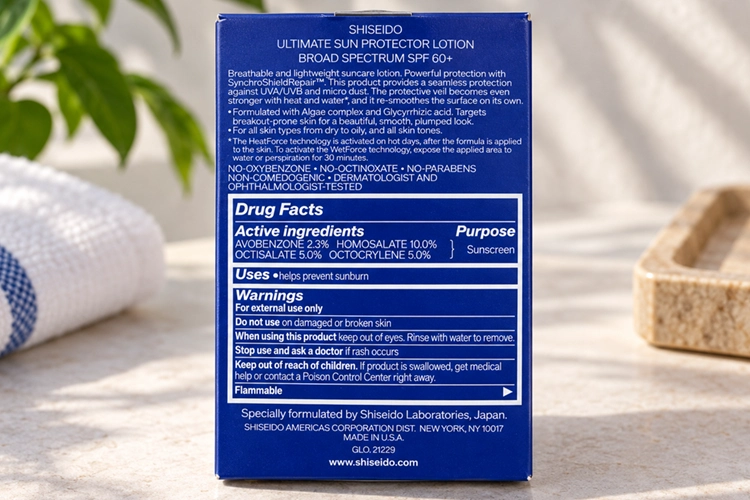
I also appreciate that the U.S. packaging uses Drug Facts labeling with the active ingredient concentrations and directions clearly presented. Another interesting detail is that 90% of the bottle body is made from plant-derived material, excluding the cap and inner flow plug.
Sun Protection & Formula
This is where the sunscreen starts to make sense as more than just a pretty luxury product. The U.S. version uses an SPF 60+ broad-spectrum organic filter system built around four primary UV filters: Avobenzone, Homosalate, Octisalate, and Octocrylene.
Key Ingredients
- Avobenzone (2.3%) – helps absorb long-wave UVA radiation, which is especially relevant to photoaging.
- Homosalate (10%) – contributes primarily to UVB protection and also helps dissolve other sunscreen ingredients.
- Octisalate (5%) – another UVB-absorbing filter that also supports the formula’s emollient feel.
- Octocrylene (5%) – provides UVB and some UVA2 absorption while helping stabilize Avobenzone.
- Hypotaurine – included for antioxidant support against oxidative stress associated with high-energy visible blue light.
- Green Tea Leaf Extract – part of the NatureSurge Complex, designed to provide antioxidant support against environmental stressors.
- 5-Algae Complex + Glycerin – helps hold moisture in the upper layers of the skin.
- Dipotassium Glycyrrhizate – a licorice-derived ingredient used for soothing and calming support.
One thing I noticed immediately is that the U.S. formula does not contain Oxybenzone or Octinoxate, which Shiseido removed in its reformulation. That will matter to shoppers who specifically avoid those filters.
Then there is the brand’s much-discussed SynchroShieldRepair™ Technology. Rather than relying on a completely static sunscreen film, the system is designed to respond to everyday stress. WetForce is intended to reinforce the protective film when exposed to water or sweat, HeatForce helps the film reorganize under heat, and flexible silicone resins help smooth over small disruptions caused by touching, rubbing, and facial movement.
That is a clever approach because sunscreen often fails in real life not because the SPF on the label is inadequate, but because the film gets disturbed.
Texture & Finish
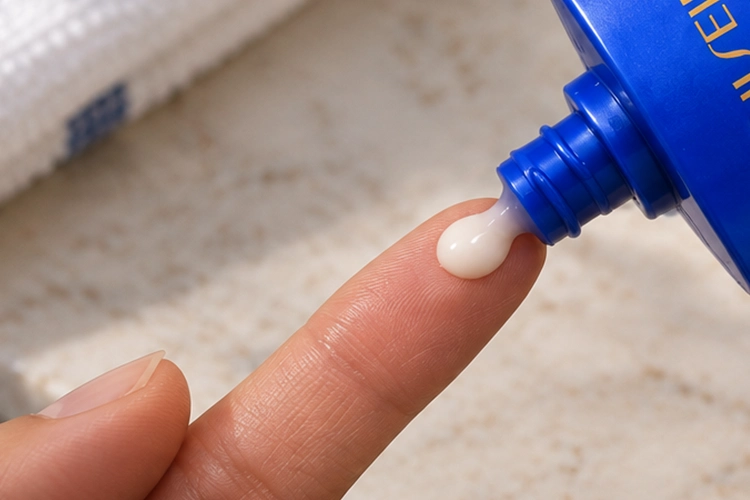
The texture is one of the reasons I understand the hype. It is very fluid, milky, and lightweight, and the volatile silicone and isododecane components help it spread quickly instead of dragging across my skin.
Despite being an SPF 60+ water-resistant formula, it does not have that thick, beach-sunscreen personality. It spreads into a thin layer and dries completely clear, with no obvious white cast because this version uses soluble organic filters rather than mineral particles.
There is still a little radiance, though. Talc and silica help reduce some of the shine and leave the finish somewhere around semi-dewy rather than greasy. My skin still looked alive instead of flat, but extremely oily skin may notice more shine than I did.
Scent
Here is where my enthusiasm gets a little more complicated. The lotion has a noticeable floral-citrus fragrance that masks the chemical odor you can sometimes get from organic UV filters.
I actually like the scent during application because it gives the product that unmistakable luxury-skincare feel, and it does not remain equally strong all day. The fragrance gradually fades as the more volatile notes disappear.
However, fragrance is still fragrance. If your eyes are sensitive, I would be cautious around the orbital area because sweat, heat, fragrance compounds, and certain organic filters can migrate and cause burning or tearing in susceptible users.
Skin Type & Compatibility
For my combination skin, the balance is surprisingly comfortable. The silicone-based system creates a breathable film rather than the dense, oily sensation I associate with some highly water-resistant sunscreens.
I also like that the formula includes licorice-derived Dipotassium Glycyrrhizate, Glycerin, and the 5-Algae Complex, because the sunscreen is trying to address both protection and moisture retention. Solar exposure can increase transepidermal water loss, so keeping the skin comfortable during prolonged exposure is not just a cosmetic extra.
For oily skin, I would describe the finish as controlled but not truly matte. For dry or dehydrated skin, I think the flexible film and humectant support are more appealing.
And for deeper skin tones, the zero-white-cast finish is a genuine advantage. There is no mineral-particle haze to fight with, which makes the sunscreen much easier to wear visibly in everyday life.
Wearability & Daily Life
This is probably the category where Shiseido earns its reputation for me. The formula is designed to cope with heat, sweat, water, and friction, which makes it especially relevant for outdoor days rather than only quiet mornings at home.
I also like how well it behaves under makeup. The film-forming silicones help create a smoother surface, and the formula is designed to layer without the familiar rolling or pilling problem.
There is also no mineral sunscreen flashback, which is useful for photographs and social events. Still, no sunscreen should be treated as indestructible. The guidance remains to reapply at least every two hours and after 80 minutes of swimming or sweating.
The trade-off is removal. This is a resilient, water-resistant film, so I would not rely on one quick splash of cleanser at night. An oil-based cleanser or micellar product followed by a water-based cleanser is the more practical approach for thorough removal.
Size, Lifespan, & Practicality
One thing I appreciate is the range of sizes. The bottle comes in 50 mL, 150 mL, and 300 mL formats, so there is a small option for travel and significantly larger choices for frequent outdoor or family use.
The bigger bottles also make more sense financially because sunscreen only works as intended when I use enough of it. The calculations provided for standard face-and-neck use estimate roughly 40 applications from 50 mL, 120 from 150 mL, and 240 from 300 mL.
One practical warning surprised me: Avobenzone can contribute to stubborn yellow, orange, or rust-colored staining on light fabrics, especially when residue encounters iron-rich hard water. That is not unique to this sunscreen, but it is something I would keep in mind when wearing white clothing.
Brand Reputation & Ethics
Shiseido has been around since 1872, so the company has had a very long time to develop its reputation for cosmetic research and formulation technology. This sunscreen is supported by dermatologist and ophthalmologist testing, and a small two-week clinical study involving 30 women reported improvements in fine lines, smoothness, and tone evenness.
I do think it is important to keep those results in perspective. A two-week study with 30 participants does not establish that the sunscreen will transform everyone’s skin, so I would treat those observations as supportive rather than miraculous.
From an environmental standpoint, I appreciate the removal of Oxybenzone and Octinoxate from this formulation, along with the plant-derived bottle material. Those changes do not make any sunscreen automatically environmentally harmless, but they are still meaningful design choices.
Price, Value, & Availability
This is absolutely a luxury sunscreen, and the pricing makes that obvious. The listed U.S. prices are $26 for 50 mL, $52 for 150 mL, and approximately $94–$96 for 300 mL.
The larger bottles dramatically lower the cost per fluid ounce, from about $16.25/oz for the 50 mL size to roughly $9.40/oz for the 300 mL size. The product is also sold through major retailers such as Nordstrom, Macy’s, Ulta, and Sephora, as well as Shiseido’s own direct channel.
So yes, the price is high. But the value proposition becomes more reasonable when I consider the combination of SPF level, clear finish, water resistance, makeup compatibility, and the larger-volume options.
Overall Rating
After looking at what the formula is actually trying to accomplish, I understand why this sunscreen has developed such a following. It manages something that sounds simple but is genuinely difficult: high protection without making me feel like I am wearing a heavy outdoor sunscreen.
I would give the Shiseido Ultimate Sun Protector Lotion SPF 60+ an overall rating of 8.1 out of 10. The texture, clear finish, durability, and everyday versatility are the strongest parts for me, while the fragrance, staining potential, cleansing requirements, and price keep it from feeling universally perfect.


Tips & Recommendations
My biggest tip is simple: shake the bottle thoroughly before every application. Because the formula is biphasic, this step matters.
I would also apply it generously and evenly rather than trying to stretch a small amount because the texture feels so light. Reapply at least every two hours when exposed to the sun, and sooner after swimming or heavy sweating.
For everyday use, I would consider the 150 mL size the most practical middle ground if you use sunscreen frequently on both face and body. The 50 mL option makes more sense when portability is the priority, while the 300 mL size is better suited to frequent outdoor use or sharing.
And finally, I would keep the sunscreen away from delicate white clothing until it has fully settled. As someone who loves wearing light colors, that little detail alone is worth remembering.
So, is the Shiseido Ultimate Sun Protector Lotion worth the hype? What convinced me was not the luxury branding. It was the fact that the formula is clearly engineered around the messy reality of sunscreen use: sweat, heat, movement, makeup, water, and the temptation to under-apply when something feels unpleasant. For me, that practical performance is where the product earns its reputation.
Shiseido Ultimate Sun Protector Lotion SPF 60+
- Very high SPF 60+ broad-spectrum protection
- Lightweight, fluid texture that spreads easily
- Zero white cast
- Designed for heat, sweat, water, and friction
- Comfortable under makeup
- Includes hydration and soothing-support ingredients
- Available in multiple sizes
- Bottle body is largely plant-derived
- Floral fragrance may bother sensitive eyes or skin
- Can remain slightly radiant on very oily skin
- Requires shaking before use
- Strong water resistance means more effort at night to remove completely
- Avobenzone may stain light-colored clothing
- Premium pricing can be difficult to justify for casual sunscreen users