

Now Reading: I Tried the Trending Mixsoon Bean Sunscreen SPF 50—Here’s What Happened
-
01
I Tried the Trending Mixsoon Bean Sunscreen SPF 50—Here’s What Happened

This post may contain affiliate links. Please read our full disclosure here.
Brand: mixsoon
Format: Sun Cream
Activity & Use Case: Daily Face Wear
Filter Type: Chemical
SPF Level & Broad Spectrum: SPF 50+, Broad-Spectrum Protection
Active Ingredients: Avobenzone 3%, Homosalate 7%, Octisalate 5%, Octocrylene 5%
Fragrance: Fragrance-Free
Water Resistance: None (Not Water-Resistant)
Special Features: Vegan, Reef-Safe, Cruelty-free
Price: Approximately $30 for a 50 mL (1.69 fl. oz.) tube; promotional prices are often around $17–$22.
I’ll be honest: the mixsoon Bean Sunscreen SPF 50 caught my attention because of the hype surrounding it. It was already a popular K-beauty sunscreen, but after SUGA was spotted applying it in a lifestyle vlog, it suddenly became one of those products that seemed to be everywhere.
I was curious whether the excitement was actually justified or whether this was simply another viral sunscreen moment. My skin is combination and slightly dehydrated—my T-zone gets shiny fairly easily, while my cheeks can feel dry and tight—so I’m particularly picky about sunscreen. I want strong protection, but I also want something comfortable enough that I’ll happily wear it every morning.
After spending time with the Bean Sunscreen, I can see why it has developed such a following. It isn’t just a celebrity-associated product; the formula itself has quite a lot going for it.
The Quick Verdict
Overall Rating: 7.8/10
Best For: Normal, dry, and combination skin looking for a lightweight, hydrating SPF 50 with a dewy, invisible finish.
Skip This If: You have very oily skin and strongly prefer a matte sunscreen, or if you want a larger, more budget-friendly sunscreen tube.
Packaging & Design
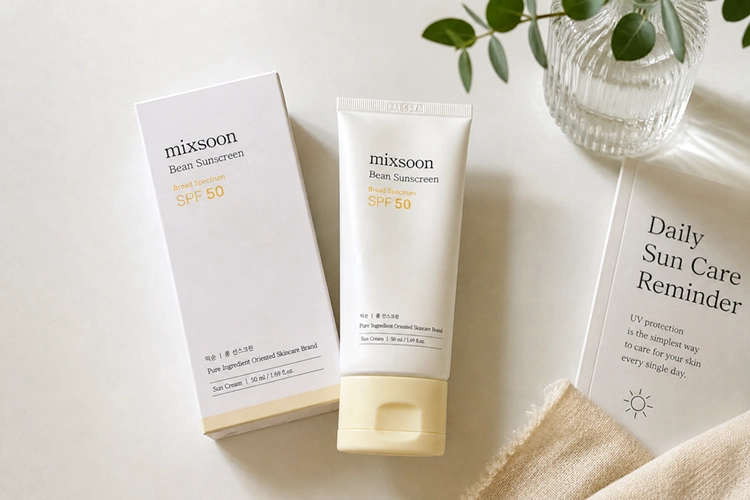
The Bean Sunscreen comes in a 50 mL (1.69 fl. oz.) flexible squeeze tube with a narrow nozzle and flip-top cap. The overall design is very much in line with mixsoon’s minimalist Korean skincare aesthetic: clean, understated, and more focused on the formula than flashy packaging.
I particularly like the narrow dispensing tip. It gives me good control over how much sunscreen comes out, which is helpful when I’m trying to apply enough without accidentally squeezing out too much.
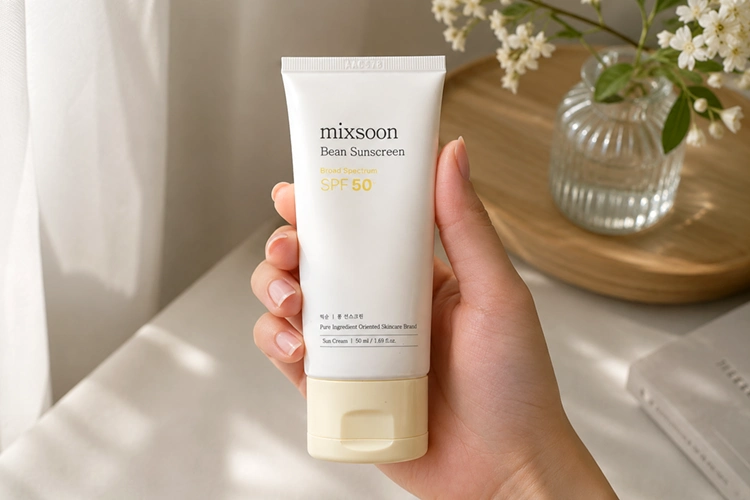
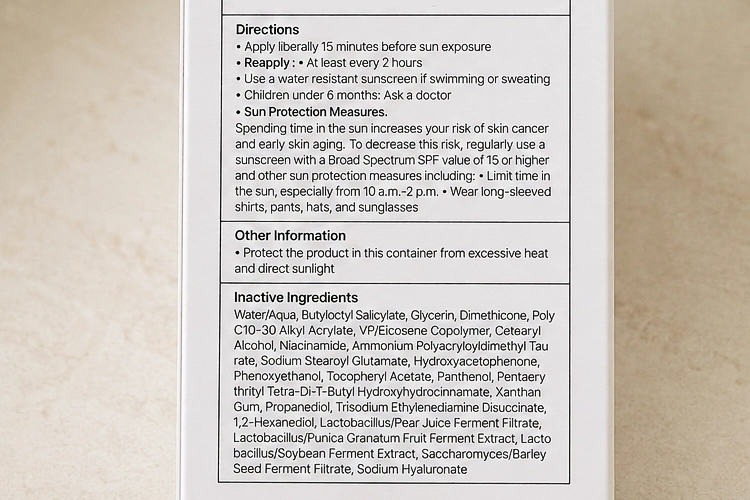
The tube is an opaque light-beige shade, while the outer carton has a simple, clean design with clear typography and a yellow SPF 50 marking. The packaging also provides the ingredient list, usage instructions, and other required product information.
The flexible tube is another practical touch. I can squeeze it thoroughly as I get toward the end rather than having to fight with a rigid container. The 50 mL size is also convenient for carrying in a handbag or travel bag.
Sun Protection & Formula
The most important thing about any sunscreen is obviously the protection, and the mixsoon Bean Sunscreen is SPF 50 with broad-spectrum UVA and UVB protection.
This is an organic, or chemical, sunscreen rather than a mineral formula. Instead of using zinc oxide or titanium dioxide, it relies on organic UV filters that absorb incoming UV radiation and convert it into low-level heat.
The filter combination includes Avobenzone, Homosalate, Octisalate, and Octocrylene. Avobenzone is particularly important because it provides UVA protection, while the other filters contribute primarily to UVB coverage and help support the overall filter system.
I also like that the formula doesn’t stop at UV filters. This is where the Bean Sunscreen starts to feel more like a skincare product than a conventional sunscreen.
Key Ingredients
- Avobenzone: Provides UVA protection, particularly against longer UVA wavelengths associated with photoaging.
- Homosalate: Primarily contributes to UVB protection and helps support the sunscreen’s filter system.
- Octisalate: Provides additional UVB absorption and helps with the formula’s spreadability.
- Octocrylene: Helps absorb UV radiation and stabilize Avobenzone.
- Lactobacillus/Soybean Ferment Extract: Provides antioxidant-rich compounds and supports the skin’s barrier.
- Pomegranate Ferment: Helps condition the skin and provides antioxidant benefits.
- Barley Ferment: Helps support hydration and provides antioxidant properties.
- Pear Ferment: Adds soothing and skin-conditioning benefits.
- Niacinamide: Helps support the skin barrier, regulate sebum, and improve the appearance of uneven pigmentation.
- Panthenol: Helps attract moisture and soothe the skin.
- Sodium Hyaluronate: Helps bind water to the skin and reduce moisture loss.
The fermented complex is probably the ingredient story that intrigued me most. It combines soybean, pomegranate, barley, and Korean pear, with fermentation used to break down botanical components into smaller compounds such as amino acids, peptides, and antioxidants.
That makes the formula feel considerably more thought-out than simply adding SPF to an ordinary moisturizer.
Texture & Finish
This was probably the biggest surprise for me.
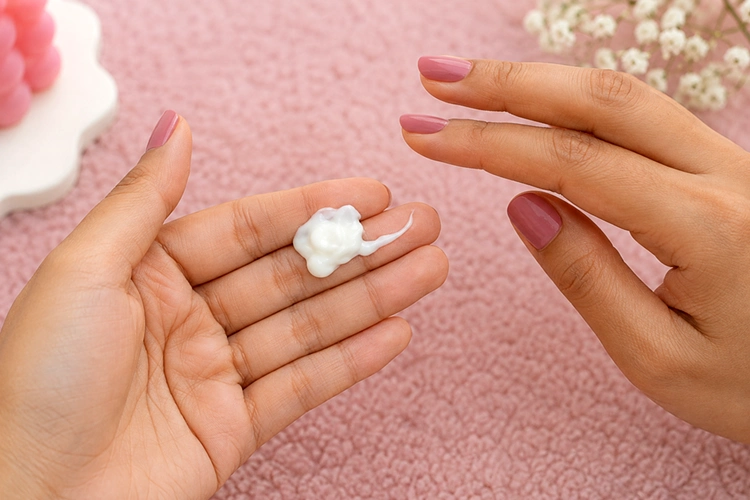
The Bean Sunscreen has a soft, lightweight cream-to-serum texture that spreads much more easily than many SPF 50 formulas I’ve tried. It doesn’t have that thick, heavy sunscreen feeling that can make me dread applying the recommended amount.
It glides across the skin without much dragging, and even when I apply a generous amount, it doesn’t immediately feel like I’ve put a thick layer of product on my face.
I do like giving it a little time to settle. With a full two-finger amount, I find that taking a minute or two to distribute everything properly gives me a much more even finish.
And the finish? Dewy, hydrated, and completely free of an obvious white cast.
That’s one of the strongest features of this sunscreen. Because it uses soluble organic filters rather than mineral particles, it dries down without leaving that pale or chalky appearance that can be particularly frustrating on deeper skin tones.
My skin still looks like my skin—just a little more hydrated and glowy.
Scent
Another easy win for me is the fragrance-free formula.
There are no added perfumes or essential oils, so I don’t get a lingering floral, fruity, or sunscreen-like fragrance after applying it. There is a very faint smell from the raw ingredients when I first dispense it, but it disappears almost immediately.
I actually prefer this in a sunscreen. I’m putting SPF on my face every day, sometimes quite close to my eyes, so I don’t particularly want unnecessary fragrance competing with the rest of my skincare routine.
The formula is also designed to minimize the movement of the sunscreen filters across the skin, and it has been reported to be comfortable around the eye area without notable watering or burning.
Skin Type & Compatibility
For my combination, slightly dehydrated skin, this formula makes a lot of sense.
The hydrating and lightweight combination gives my cheeks some much-needed comfort without making the rest of my face feel excessively coated. Ingredients such as panthenol, sodium hyaluronate, and the fermented extracts help give it that skincare-like quality.
I think normal, dry, and combination skin will probably appreciate the formula most, particularly if you enjoy a naturally radiant finish.
Sensitive or reactive skin may also find the fragrance-free approach appealing. The formula is described as hypoallergenic and has undergone primary skin irritation testing.
If you have very oily skin, though, your experience may be different. The texture itself is lightweight, but the finish is intentionally dewy. In extremely hot or humid conditions, I can see some people finding that glow a little too rich.
Wearability & Daily Life
This is where I think the Bean Sunscreen really earns its popularity.
There are plenty of sunscreens that technically work but make me feel like I’m wearing sunscreen. This one feels much closer to a hydrating skincare step with SPF 50 built in.
It also works nicely under makeup. The formula contains smoothing ingredients such as Dimethicone and Cetearyl Alcohol, which help create a more even surface for foundation and concealer.
Once the sunscreen has settled, makeup can be applied over it without the foundation immediately sliding around or separating. I also appreciate that the formula doesn’t contain mineral particles that can create visible flashback in photographs.
Reapplication is still the tricky part, as it is with almost every liquid sunscreen. One practical option is gently patting a smaller amount over makeup with a damp sponge. For easier touch-ups, mixsoon also offers the Bean Sun Stick as a companion product.
At the end of the day, the sunscreen doesn’t require an elaborate removal routine. A gentle cleanser or basic double-cleansing routine can remove it.
Size, Lifespan, & Practicality
The 50 mL tube is convenient, but I wouldn’t call it particularly generous for a sunscreen that I’m supposed to apply generously and consistently.
Using the standard facial amount of approximately 1.25 mL per application, one tube provides around 40 facial applications. That means roughly 40 days with one daily application, or closer to 20 days if you’re applying twice a day.
Of course, covering the neck and reapplying throughout the day will make that tube disappear faster.
Still, there’s an argument for the product’s practicality because it combines several steps. For me, it can function as a hydrating layer, moisturizer, makeup-prep step, and sunscreen in one.
The compact tube is also much easier to carry around than a large bottle, which makes it convenient for travel and everyday use.
Brand Reputation & Ethics
Mixsoon has built much of its identity around minimalist skincare and fermentation-focused formulations, and the Bean Sunscreen fits neatly into that philosophy.
The brand uses low-temperature extraction for its botanical ingredients and follows that with a controlled 72-hour fermentation process. The idea is to preserve useful plant compounds while breaking them down into forms that work well within the skincare formula.
I also appreciate the brand’s stated ethical positioning. The Bean Sunscreen is described as vegan and cruelty-free, and the formulation is free from PEGs, parabens, synthetic dyes, and artificial fragrances.
It also doesn’t contain oxybenzone or octinoxate, which the brand positions as part of its reef-friendly approach.
Those details aren’t the reason I’d buy a sunscreen on their own, but they do add to the overall appeal when the product already performs well cosmetically.
Price, Value, & Availability
The listed price for the Bean Sunscreen is around $30 for 50 mL, which puts it on the expensive side compared with many everyday sunscreens.
I wouldn’t necessarily pay full price without thinking twice, particularly because the 50 mL tube can be used up fairly quickly with proper application.
The good news is that it is often available for considerably less. Promotional prices can fall into the $17–$22 range, particularly through Amazon and K-beauty retailers.
At that lower price, I think the value becomes much stronger. You’re getting SPF 50 protection, a genuinely elegant texture, no white cast, a fragrance-free formula, and a collection of skincare ingredients in a single product.
Mixsoon also offers bundles with other products from its Bean range, which can be worth considering if you’re already a fan of the line.
Overall Rating
I’d give the mixsoon Bean Sunscreen SPF 50 a 7.8 out of 10.
After trying it, I understand why this sunscreen has developed such a following. The celebrity connection may have introduced it to a much wider audience, but the formula itself is what makes it worth talking about.
The lightweight texture, invisible finish, fragrance-free formula, hydrating feel, and makeup compatibility all work together extremely well. I particularly love that I can apply a proper amount without ending up with a thick white layer sitting on top of my skin.
My only real reservations are the 50 mL size and the full $30 price. But when I can find it around the $17–$22 range, I think the value is much easier to justify.
For me, this is the kind of sunscreen that makes daily SPF feel less like a chore and more like a pleasant part of my skincare routine.


Tips & Recommendations
My biggest tip is to give the sunscreen a little time to settle before applying makeup. I wouldn’t rush foundation directly onto freshly applied SPF. Letting the protective film form properly can help reduce the chance of pilling and gives makeup a smoother base.
I also wouldn’t let the lightweight texture fool you into applying too little. The fact that it feels more like a serum doesn’t mean you should skimp on the amount needed for adequate protection.
If you have normal, dry, or combination skin and enjoy a fresh, dewy finish, this is the group I’d recommend it to most strongly. It’s especially appealing if you dislike white cast, don’t want fragrance in your sunscreen, or want an SPF that can also act as a moisturizing makeup base.
If you’re very oily or live somewhere extremely hot and humid, I’d think about how much glow you’re comfortable with before buying. The Bean Sunscreen isn’t trying to be matte, and that’s an important part of its character.
And finally, don’t buy it just because it’s viral. The BTS connection definitely made me curious, but after looking beyond the hype, I think the formula, finish, and everyday wearability are what actually make the mixsoon Bean Sunscreen worth trying.
Mixsoon Bean Sunscreen SPF 50
- SPF 50 broad-spectrum UVA/UVB protection
- Lightweight cream-to-serum texture
- No obvious white cast
- Naturally dewy, hydrated finish
- Completely fragrance-free
- Works well under makeup
- Contains fermented soybean, pomegranate, barley, and pear extracts
- Includes niacinamide, panthenol, and sodium hyaluronate
- Comfortable for everyday wear
- Compact and travel-friendly packaging
- Vegan and cruelty-free
- Dewy finish may be too much for very oily skin
- Needs a little time to settle before makeup
- Can potentially pill if makeup is applied too quickly
- 50 mL size can be used up quickly
- $30 full price feels expensive