

Now Reading: I Tested Good Molecules Sheer Mineral Sunscreen Every Day for a Month
-
01
I Tested Good Molecules Sheer Mineral Sunscreen Every Day for a Month

This post may contain affiliate links. Please read our full disclosure here.
Brand: Good Molecules
Format: Facial Sunscreen Lotion
Activity & Use Case: Daily Face Wear, Everyday Urban Use
Filter Type: Mineral (Zinc Oxide-Based; Includes an SPF-Boosting Ingredient)
SPF Level & Broad Spectrum: SPF 30, Broad-Spectrum UVA/UVB Protection
Active Ingredients: 13.3% Zinc Oxide (Non-Nano)
Fragrance: Fragrance-Free (No Added Synthetic Fragrance or Essential Oils)
Water Resistance: None (Not Water-Resistant)
Special Features: Vegan, Cruelty-Free, Moisturizing Ingredients
Price: Approximately $12 for a 50 mL (1.7 fl oz) tube.
Finding a mineral sunscreen that protects my skin without leaving me looking like a powdered donut has always felt like an unnecessarily difficult beauty challenge. So, I decided to give Good Molecules Sheer Mineral Sunscreen SPF 30 a closer look and make it part of my daily skincare routine for a month to see whether its affordable price, gentle-looking formula, and promise of a sheer finish could live up to expectations.
For context, I have normal-to-dry skin that occasionally feels dehydrated and can become sensitive when I introduce new products. I prefer lightweight skincare, dislike heavy sunscreen residue, and want a formula that sits comfortably under makeup. I also care about ingredients, especially when I am applying something to my face every single morning.
Mineral sunscreens can be fantastic, but their thick textures and visible white casts have made me hesitate in the past. Good Molecules promises a more wearable alternative with zinc oxide as its primary UV filter, plus moisturizing ingredients to make daily application easier.
Was it worth adding to my routine? Let’s get into the packaging, formula, finish, and the practical details that matter when you’re choosing an everyday sunscreen.
The Quick Verdict
Overall Rating: 8.3/10
Best For: Normal-to-dry skin, fragrance-conscious shoppers, and those looking for an affordable mineral SPF 30 with a moisturizing, dewy finish for everyday facial use.
Skip This If: You need water-resistant protection for swimming or sweaty workouts, prefer a matte finish, have very oily skin, or want a sunscreen guaranteed to leave no white cast on deeper skin tones.
Packaging & Design
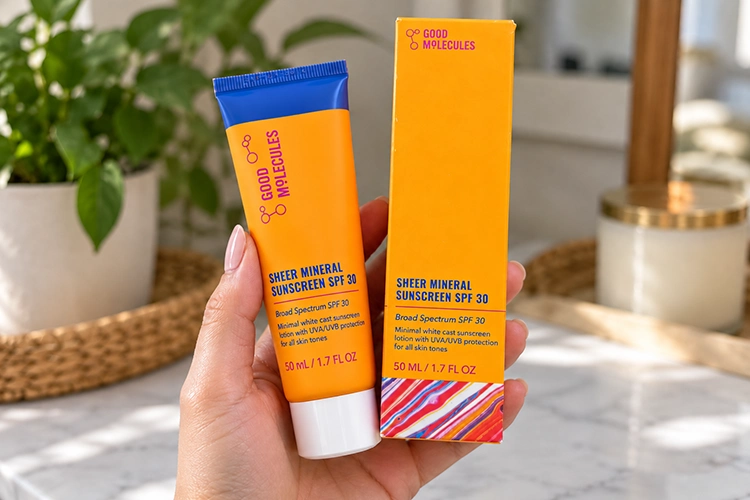
Good Molecules keeps things refreshingly simple with an opaque, flexible squeeze tube and screw-top cap. The packaging holds 50 mL (1.7 fl oz), making it compact enough to tuck into a handbag, makeup bag, or travel toiletry kit.
I appreciate packaging that prioritizes practicality over elaborate presentation. The tube is easy to handle, and the screw-top cap keeps the opening covered between uses while allowing me to access the product whenever I need it.
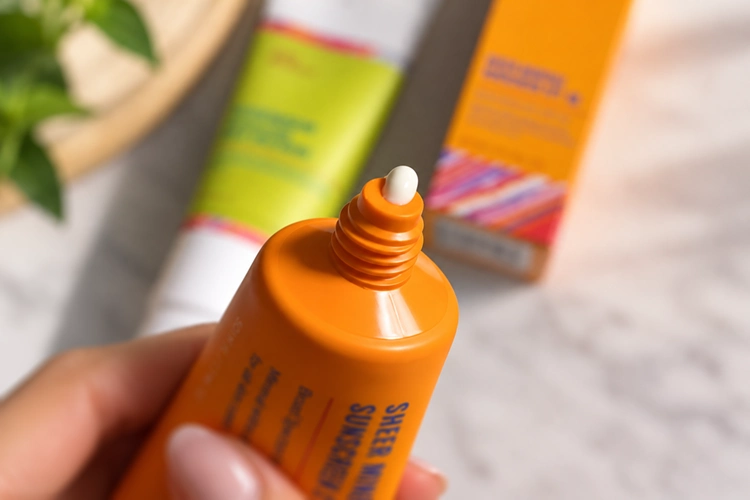
The opaque packaging is also useful because it limits the formula’s exposure to light during storage. I like that the tube is flexible, too, since it allows me to squeeze out most of the remaining product instead of struggling with a rigid bottle.
There is one small downside: sunscreen can collect around the dispensing opening and dry into a little crust if I don’t wipe it clean occasionally. It’s hardly a dealbreaker, but keeping the cap and nozzle tidy helps.
Overall, the design is uncomplicated, travel-friendly, and functional. The relatively small size also makes it easy to carry sunscreen for reapplication rather than treating it as a product that only belongs on my bathroom shelf.
Sun Protection & Formula
Let’s start with the most important thing: sunscreen needs to protect skin, not simply make it look glowy.
Good Molecules Sheer Mineral Sunscreen is labelled broad-spectrum SPF 30, with 13.3% non-nano zinc oxide as its primary active mineral UV filter. Zinc oxide helps protect against both UVB rays, which are associated with sunburn, and UVA rays, which contribute to premature skin ageing and other forms of sun damage.
I like the straightforward appeal of a zinc oxide-based sunscreen, particularly for everyday facial use. However, mineral doesn’t automatically mean more effective or suitable for everyone. The protection you receive depends on the finished formula, how generously you apply it, and whether you reapply it appropriately.
One detail worth understanding is that the formula also contains Butyloctyl Salicylate, an ingredient used as a solvent and SPF booster. It is not classified as an active sunscreen filter under the US FDA’s over-the-counter sunscreen monograph, so this is not a formula consisting exclusively of ingredients that contribute to protection through a purely mineral mechanism.
Key Ingredients
- Zinc Oxide (13.3%): The primary mineral UV filter, helping protect against UVA and UVB radiation.
- Coco-Caprylate (7%): A lightweight emollient that helps the lotion spread smoothly without excessive dragging.
- Caprylic/Capric Triglyceride (5%): Helps soften skin and support a comfortable, conditioned feel.
- Butyloctyl Salicylate (5%): Helps dissolve and distribute ingredients while boosting measured SPF performance.
- Propanediol (3%): A humectant that helps attract and retain moisture in the upper layers of the skin.
- Grape Seed Oil (2%): An emollient containing fatty acids and antioxidant compounds that support the skin-conditioning aspect of the formula.
- Tocopherol (Vitamin E, 0.75%): An antioxidant that helps protect oils in the formula from oxidation.
- Tucuma Seed Butter (0.5%): Adds emollience and helps reduce moisture loss.
- Bisabolol (0.2%): A soothing ingredient that may help calm the feeling of irritation.
- Sodium Hyaluronate (0.1%): A form of hyaluronic acid that attracts water to help keep skin feeling hydrated.
- Tetrahexyldecyl Ascorbate (0.05%): An oil-soluble vitamin C derivative included for its antioxidant and skin-conditioning properties.
The combination of mineral protection and moisturizing ingredients is appealing to me because I don’t want my sunscreen to leave my skin feeling tight by lunchtime. Still, antioxidants and hydrating ingredients are supporting players here; they do not replace the need for adequate UV protection.
My biggest caution is that this sunscreen is not water-resistant. It’s intended for everyday wear rather than swimming, sweaty workouts, or other activities involving substantial perspiration. For those situations, I’d choose a sunscreen labelled water-resistant for the appropriate duration.
Texture & Finish
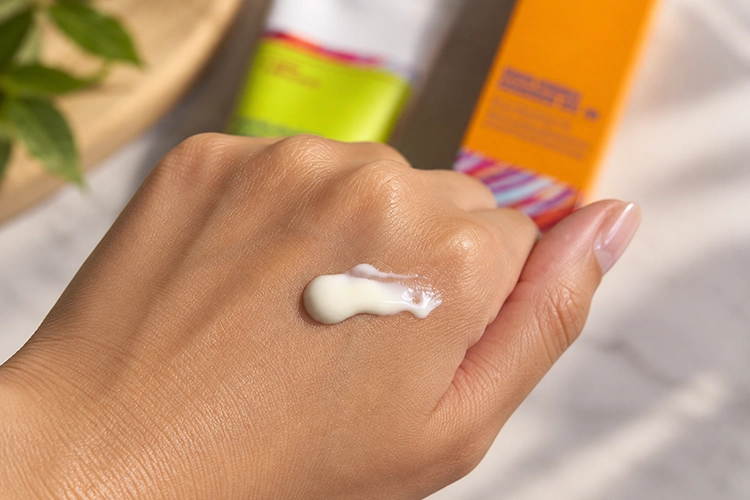
Texture is where this sunscreen becomes interesting. Mineral formulas often have a reputation for being thick, pasty, and difficult to blend, but this one has a medium-light lotion consistency that spreads without much tugging.
It initially looks white when dispensed, which is entirely expected from a zinc oxide sunscreen. With thorough blending, the visible whiteness becomes less pronounced, and the formula is designed to leave a relatively minimal white cast compared with heavier mineral formulations.
I particularly like the idea of a sunscreen that feels more like skincare than a heavy protective coating. The emollients help the formula glide over the skin, while the moisturizing ingredients contribute to a comfortable finish.
The finished appearance is dewy to softly luminous, rather than completely matte. On normal-to-dry skin, that can be lovely because it gives the complexion a fresh, hydrated look without necessarily requiring another glowy product.
The sunscreen takes approximately two to four minutes to dry down, so I wouldn’t apply it and immediately start layering foundation. Giving it a little breathing room helps the protective film settle.
One important consideration is white cast. Although the formula is designed to minimize it, no mineral sunscreen can guarantee an invisible finish on every complexion. A faint, cool-toned cast may remain on deeper skin tones, especially if the product is applied heavily without thorough blending. I’d recommend testing it in daylight before committing to it as your everyday face sunscreen.
Pilling is another potential issue, particularly when it’s layered over rich, silicone-heavy moisturizers or facial oils that haven’t absorbed. A simpler skincare routine may help the sunscreen sit more evenly.
Scent
Good news for anyone who avoids strongly fragranced skincare: the formula contains no added synthetic fragrance or essential oils.
Rather than smelling like a tropical holiday or a heavily perfumed moisturizer, it may have a faint, neutral scent from its raw ingredients, including grape seed oil and tucuma seed butter. This subtle scent is expected to dissipate quickly.
I appreciate fragrance-free formulas because strong fragrance isn’t something I need in a product designed for everyday facial use. However, fragrance-free doesn’t automatically mean allergy-proof, and even gentle-looking formulas can disagree with individual skin.
The lack of added fragrance is a plus for anyone who prefers a quieter skincare routine or finds strongly scented products unpleasant.
Skin Type & Compatibility
Based on the formula, I’d place this sunscreen in the normal-to-dry and potentially sensitive-skin-friendly category. The moisturizing ingredients can help support skin comfort, while zinc oxide and bisabolol may appeal to people who prefer a relatively simple, fragrance-free sunscreen.
For my normal-to-dry skin profile, the dewy finish sounds much more appealing than a sunscreen that dries down into an uncomfortable, chalky layer. Grape seed oil, tucuma seed butter, and humectants contribute to the formula’s conditioning qualities.
However, sensitive skin is individual. Anyone managing eczema, rosacea, a compromised skin barrier, or sensitivity after a procedure should patch-test the product and follow their dermatologist’s advice. The formula isn’t guaranteed to prevent irritation, and its reported pH of approximately 8 is higher than the skin’s naturally acidic surface environment.
Although some of the emollients are generally considered relatively low in comedogenic potential, the formula also includes ingredients such as cetearyl alcohol and butyloctyl salicylate that may not suit every breakout-prone complexion. That doesn’t mean they’ll automatically clog your pores, but it’s worth paying attention to how your skin responds.
The dewy finish may also become noticeably shiny throughout the day if your skin produces a lot of oil. A light dusting of setting powder could help, although I’d avoid layering on so many products that the sunscreen starts to pill.
If you’re acne-prone, introduce it gradually and monitor your skin rather than assuming that a mineral formula is automatically non-comedogenic.
Wearability & Daily Life
An everyday sunscreen needs to fit into my routine without turning getting ready into a complicated process. This formula is designed to work alongside skincare and makeup, which makes it a practical candidate for ordinary mornings.
My preferred application order is simple: water-based serums first, followed by moisturizer if my skin needs it, then sunscreen. I would allow the skincare underneath to settle before applying the sunscreen, and then give the sunscreen approximately two to three minutes before moving on to foundation or concealer.
The smooth-spreading emollients should help liquid foundation glide across the surface, while the formula’s relatively sheer finish is intended to avoid the obvious, heavy appearance associated with some mineral sunscreens. It should also produce less flashback in photography than some highly opaque formulas, although results can vary with lighting and other makeup products.
The biggest daily-life consideration is reapplication. Sunscreen generally needs to be reapplied at least every two hours while you’re outdoors, and sooner after swimming, heavy sweating, or towel drying. Because this formula isn’t water-resistant, I’d be especially careful not to rely on it for long outdoor activities.
Reapplying over makeup can be awkward. Pressing sunscreen gently into the skin with a clean, damp makeup sponge may be one option, although the technique needs to preserve reasonably even coverage. Applying it to bare skin is simpler when practical.
Removal should be relatively straightforward because the formula isn’t built around a water-resistant film. A gentle cleanser may be sufficient, depending on how much you’ve applied and whether you’re also wearing makeup.
Size, Lifespan, & Practicality
The 50 mL tube is compact, but don’t confuse compact packaging with a product that will last forever.
For a full application to the face and neck, a commonly used guideline is approximately 1/4 teaspoon, or around 1.25 mL, although the precise amount varies with facial size and application technique. At that rate, a 50 mL tube provides roughly 40 applications.
That means one application every morning would use up a tube in around 40 days. Using it as directed during extended outdoor exposure, with regular reapplication, will reduce that lifespan considerably.
This is worth considering when budgeting for daily SPF. A product can be affordable upfront but still need frequent replacement if you’re using an adequate amount, which is exactly what you should be doing.
The tube is small enough for travel, and its 50 mL volume falls within the standard 100 mL limit for individual liquids in many airport carry-on systems, though specific airport rules can vary.
The stated 12-month period after opening is another useful detail. I’d still store it according to the packaging instructions and avoid leaving it somewhere excessively hot, such as a car in direct sunlight.
As for clothing, white mineral residue can transfer to darker fabrics. The formula isn’t expected to produce the characteristic permanent rust-coloured staining associated with certain avobenzone-containing sunscreens, and ordinary detergent should help remove typical zinc oxide residue. Nevertheless, I’d let the product settle before getting dressed.
Brand Reputation & Ethics
Good Molecules has built its appeal around accessible skincare and ingredient transparency, and this sunscreen fits that general approach. Its relatively straightforward packaging and budget-friendly positioning make it attractive to shoppers who want to understand what they’re putting on their skin without paying prestige beauty prices.
One feature I find particularly useful is the product’s ingredient transparency, including disclosed percentages for key ingredients. Knowing that the formula contains 13.3% zinc oxide, for example, gives shoppers more context than a vague promise of mineral protection alone.
The sunscreen is also described as vegan and cruelty-free, which may matter if you consider animal welfare when choosing beauty products.
Its non-nano zinc oxide and avoidance of certain controversial chemical UV filters may appeal to environmentally conscious shoppers. However, I’d be cautious about interpreting any sunscreen as completely harmless to marine environments. Environmental impact depends on several factors, and labels such as “reef-safe” aren’t a universal guarantee of ecological safety.
The formula also uses naturally derived gums, including xanthan gum and acacia Senegal gum, rather than relying on the particular synthetic microplastic polymers discussed in some skincare debates.
Overall, the combination of affordability, formula transparency, and stated ethical commitments is appealing, although shoppers with specific environmental concerns should examine the product’s full ingredient list and brand policies.
Price, Value, & Availability
At the listed US price of $12 for 50 mL (1.7 fl oz), Good Molecules Sheer Mineral Sunscreen sits in the affordable end of the facial sunscreen market. That works out to approximately $7.06 per fluid ounce, making it considerably less expensive by volume than many prestige mineral sunscreens.
For someone who applies sunscreen every day, that difference matters. Facial SPF isn’t an occasional luxury product; it needs to be used generously and replaced regularly.
The brand’s listed multipack options include two tubes for $24 and three for $36, which work out to the same price per tube before any applicable taxes, shipping fees, or promotions. Travel-friendly sizing may also appeal to shoppers who want to keep sunscreen within easy reach.
Availability and pricing can vary by retailer, country, and shipping destination, so I’d check the official Good Molecules store or an authorized retailer for the current local price before purchasing.
For me, the main value proposition is easy to understand: a fragrance-free, SPF 30 mineral sunscreen with moisturizing ingredients at a relatively accessible price. The compromise is that it’s not water-resistant, and the dewy finish won’t necessarily suit everyone.
Overall Rating
My overall rating: 8.3 out of 10 stars.
Good Molecules Sheer Mineral Sunscreen SPF 30 checks several important boxes for an everyday facial sunscreen. It combines mineral UV protection with moisturizing ingredients, avoids added fragrance, and comes at a price that feels accessible compared with many premium alternatives.
The texture and soft, luminous finish are its strongest selling points on paper, particularly for someone with normal-to-dry skin who wants sunscreen to fit comfortably into a morning routine.
The limitations matter, though. The lack of water resistance makes it less versatile, and the possibility of white cast or pilling means the finish won’t be perfect for everybody. Oily or acne-prone skin may also need a little trial and error to determine compatibility.
I’d consider it a promising everyday option for people who want an affordable mineral sunscreen for routine use, provided they apply enough, reapply appropriately, and choose a water-resistant alternative when their activities call for one.
Would I recommend it? Yes, with a few qualifications. It’s a strong contender for a daily SPF routine, but the right sunscreen is ultimately the one that protects your skin, suits your complexion, and feels comfortable enough that you’ll use it consistently.


Tips & Recommendations
After considering the formula, here’s how I’d approach using this sunscreen for the best experience.
1. Apply enough. Don’t stretch a tiny dot across your entire face and assume you’ve received the labelled SPF 30 protection. Apply a generous, even layer to the face, neck, ears, and other exposed areas.
2. Give it time to settle. Allow approximately two to four minutes for the formula to dry down before applying makeup. If you notice pilling, simplify your skincare layers and allow each product to absorb before adding the next.
3. Test the finish in daylight. The formula is designed to minimize white cast, but the result can differ across skin tones. Check how it looks in natural lighting before relying on it for everyday makeup.
4. Adjust for your skin type. Normal-to-dry skin may appreciate the soft, dewy finish. If you have oily skin, try a small amount of setting powder once the sunscreen has settled. If you have acne-prone skin, introduce it gradually and observe any changes.
5. Reapply throughout the day. Reapply at least every two hours during outdoor exposure and after swimming, sweating, or towel drying. Since this sunscreen is not water-resistant, choose an appropriately labelled water-resistant sunscreen for swimming and strenuous outdoor activity.
6. Keep your routine simple. A lightweight serum followed by a suitable moisturizer, if needed, can make layering easier. Too many rich products underneath may increase the chance of pilling.
7. Patch-test if your skin is reactive. Fragrance-free doesn’t mean irritation is impossible. Test the product on a small area before applying it all over your face, particularly if you have a history of reactions or a compromised skin barrier.
8. Check the packaging. Follow the product’s storage instructions and the 12-month period-after-opening guidance. Keep the cap clean, close the tube properly, and avoid exposing it to excessive heat.
One last reminder: SPF is only one part of sun protection. Shade, protective clothing, sunglasses, and sensible decisions about prolonged exposure still matter. A sunscreen labelled SPF 30 can be a useful part of a daily routine, but how much you apply and how consistently you reapply it make a real difference.
My final take? Good Molecules Sheer Mineral Sunscreen SPF 30 is worth considering if you want an affordable, fragrance-free mineral formula with a moisturizing, dewy finish. It isn’t a universal holy grail, and it won’t replace a water-resistant sunscreen for active days, but it offers a practical starting point for building a more consistent daily sun-care routine.
Good Molecules Sheer Mineral Sunscreen SPF 30
- Affordable price: The listed $12 price makes daily facial sunscreen more budget-friendly.
- Mineral UV protection: Uses 13.3% non-nano zinc oxide in a broad-spectrum SPF 30 formula.
- Fragrance-free formula: No added synthetic fragrance or essential oils.
- Comfort-focused ingredients: Includes humectants, emollients, antioxidants, and soothing bisabolol.
- Lightweight lotion texture: Designed to spread smoothly without the heavy feel associated with some mineral sunscreens.
- Soft, dewy finish: Particularly appealing for normal-to-dry skin.
- Compact, practical packaging: Easy to carry and convenient for everyday application.
- Vegan and cruelty-free positioning: A plus for shoppers who prioritize these stated brand commitments.
- No water resistance: Not my pick for swimming, sweaty workouts, or prolonged, high-intensity outdoor activities.
- Possible white cast: The finish may not be completely invisible on deeper skin tones.
- Dewiness can become shine: Oily skin types may want setting powder or a different finish.
- Potential pilling: Rich moisturizers, facial oils, and heavy layering may interfere with the finish.
- May not suit every acne-prone complexion: Individual tolerance to the emollients and other ingredients varies.
- Small tube: Regular, generous application means replacing it more frequently than the packaging size might suggest.