

Now Reading: Black Girl Sunscreen SPF 30 Review: I Tried It for a Month (2026)
-
01
Black Girl Sunscreen SPF 30 Review: I Tried It for a Month (2026)

This post may contain affiliate links. Please read our full disclosure here.
Brand: Black Girl Sunscreen
Format: Lotion
Activity & Use Case: Daily Face Wear, Body Sunscreen
Filter Type: Chemical
SPF Level & Broad Spectrum: SPF 30+, Broad Spectrum
Active Ingredients: 3% Avobenzone, 10% Homosalate, 5% Octisalate, 2.75% Octocrylene
Fragrance: Fragrance-Free
Water Resistance: 80 min
Special Features: Vegan, Cruelty-free, Reef-Safer Formula
Price: Approximately $15.99–$18.99 for the 3.0 fl. oz. (89 mL) tube; the 2.0 fl. oz. travel size is around $10.99.
I have a confession: for years, sunscreen was one of those skincare steps I understood perfectly in theory but struggled to enjoy in practice. A lot of formulas either made my skin look ashy, felt heavy, or left me shiny enough to notice it before I had even finished my morning coffee. So when I spent a month using Black Girl Sunscreen SPF 30 Face & Body, a product built specifically around the idea of invisible protection on deeper skin tones, I was genuinely curious to see whether it could become an everyday favorite rather than just another tube in my cabinet.
My skin is combination and slightly dehydrated, with an oilier T-zone, normal cheeks, and the occasional sensitivity around my nose and under-eye area. I also have a deeper skin tone, so avoiding a gray or purple cast is not a cosmetic bonus for me—it is one of my basic requirements for sunscreen.
After a month of using it on my face, neck, and occasionally my arms, I came away with a pretty clear opinion: this is a very approachable sunscreen with excellent cosmetic elegance, especially if your skin leans normal, dry, or combination. It is not perfect, but it solves one of the most frustrating sunscreen problems beautifully.
The Quick Verdict
Overall Rating: 8.3/10
Best For: Normal, dry, and combination skin, especially deeper skin tones looking for a moisturizing sunscreen with no white cast.
Skip This If: You have very oily skin and strongly prefer a matte finish, or chemical sunscreen filters tend to sting your eyes or sensitive skin.
Packaging & Design
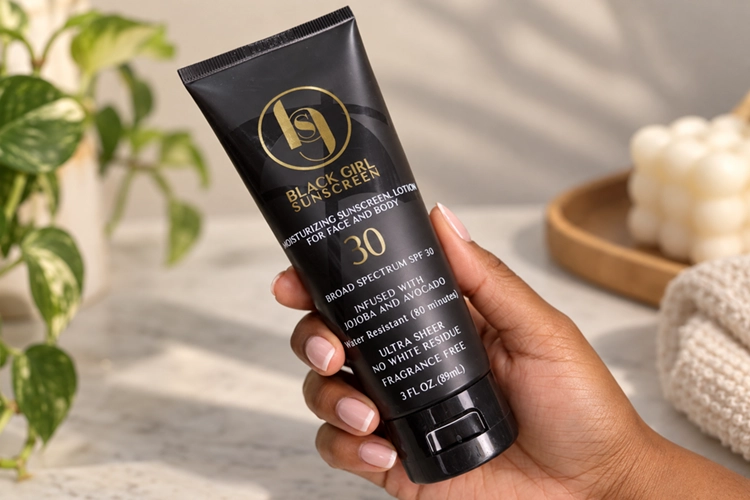
The first thing that stands out is the matte-black squeeze tube with gold and white lettering. It looks polished without trying too hard, and I like that it doesn’t have the typical overly beachy appearance of many body sunscreens.
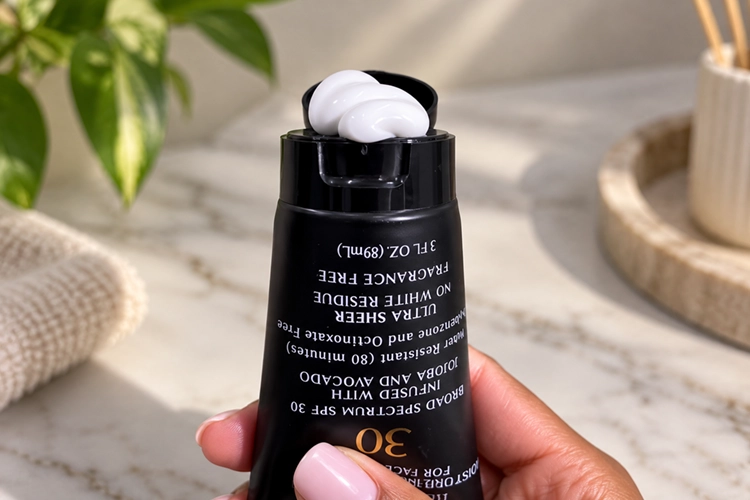
The tube itself is made from flexible plastic and uses a flip-top cap, which makes it easy to dispense without having to unscrew anything while my hands are slippery. The flexibility is also practical because I could squeeze out almost everything as I reached the bottom instead of leaving a frustrating amount trapped inside.
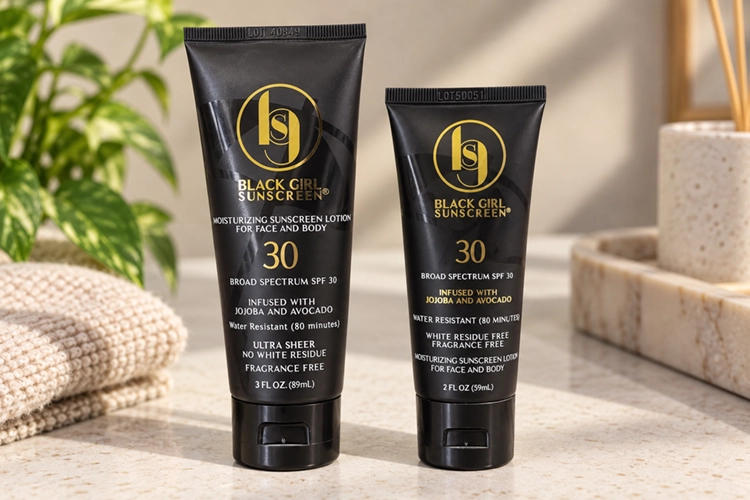
One downside of the opaque packaging is that I couldn’t actually see how much sunscreen was left. I had to judge by the tube’s weight, and the flip-top neck did occasionally collect a little dried product around the opening. Nothing dramatic, but it is something I noticed after frequent use.
The standard tube contains 3.0 fl. oz. (89 mL), while a 2.0 fl. oz. travel size is also available. The full-size tube is particularly convenient for travel because it remains below the TSA’s 3.4 fl. oz. liquid limit.
Sun Protection & Formula
Black Girl Sunscreen SPF 30 is a chemical sunscreen, meaning its UV filters absorb ultraviolet radiation rather than sitting on the skin as reflective mineral particles. The formula uses four FDA-approved organic filters to provide broad-spectrum protection.
That filter combination is one of the reasons the sunscreen can dry down without the visible residue that can happen with zinc oxide or titanium dioxide formulas on deeper skin tones.
Key Ingredients
- Avobenzone (3%) – Provides primary UVA protection, including wavelengths associated with photoaging and pigmentation.
- Homosalate (10%) – Primarily absorbs UVB radiation and contributes to the product’s SPF 30 protection.
- Octisalate (5%) – Adds additional UVB protection while also helping with the formula’s texture.
- Octocrylene (2.75%) – Absorbs UV and helps stabilize avobenzone during sun exposure.
- Avocado Oil – Brings emollient fatty acids and vitamin E to the formula, making it more nourishing.
- Jojoba Oil – Helps soften the skin and contributes to the comfortable, moisturizing feel.
- Sunflower Seed Oil – Provides linoleic acid and helps support the skin barrier.
- Aloe Leaf Juice – Adds lightweight hydration and a soothing quality.
- Carrot Seed Oil & Cocoa Butter – Provide antioxidant-rich botanical ingredients and help support the skin’s conditioned feel.
What impressed me most was how well the formula balances protection with skincare-like comfort. It also offers 80 minutes of water and sweat resistance, which makes it substantially more practical than a sunscreen that works only for quiet mornings indoors.
The formula also leaves out oxybenzone and octinoxate, as well as parabens, silicones, and aluminum. Those exclusions will be particularly appealing to shoppers who are intentionally looking for a simpler formula from an ingredient-preference standpoint.
Texture & Finish
This is probably where I understood the appeal of Black Girl Sunscreen immediately.
The lotion comes out as a white (off white), medium-weight emulsion. It is richer than the very watery sunscreens I’ve used recently, but it spreads surprisingly easily and doesn’t require aggressive rubbing to disappear.
And yes, the biggest selling point is real: I did not get a white cast. Once blended in, the sunscreen became translucent on my skin instead of leaving that frustrating gray, lavender, or chalky film that can make you feel as though you have put face paint on by accident.
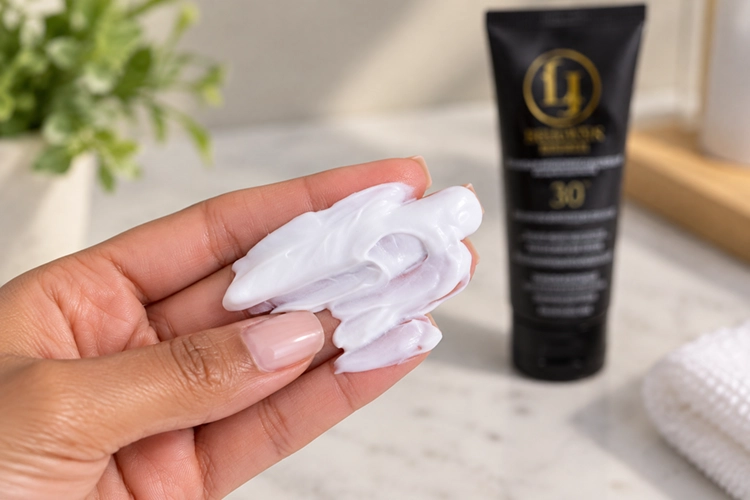
It takes a few minutes to fully settle, and during that time it looks noticeably dewy. After roughly two to five minutes, the finish becomes more uniform, but it still retains a radiant quality rather than turning matte.
For my combination skin, that was both a positive and a slight annoyance. My cheeks looked healthy and hydrated, but my forehead could become noticeably glossy by midday.
Scent
One thing I appreciated immediately was the absence of added fragrance.
There is still a subtle natural smell when the sunscreen first goes on. I noticed something slightly warm and earthy, with a faint cocoa-like quality, which makes sense given the carrot seed oil and cocoa-derived ingredients in the formula.
Fortunately, the scent isn’t persistent. It fades within a few minutes, so once the sunscreen had settled, I wasn’t walking around smelling like I had deliberately applied a scented body product to my face.
For anyone who gets headaches or irritation from strongly perfumed skincare, this is a meaningful advantage.
Skin Type & Compatibility
I think this sunscreen makes the most sense for normal, dry, and combination skin. The botanical oils and emollient texture give it enough richness that dry skin may actually be able to skip a separate morning moisturizer.
My own combination skin liked that most of the time. On days when my skin felt dehydrated, I could apply my serum followed by Black Girl Sunscreen and feel sufficiently moisturized without adding another cream.
Very oily skin is a different story. The finish can become quite shiny, particularly in hot or humid weather, and I can see someone with an oily T-zone preferring something more matte. The brand itself offers Make It Matte SPF 45 for people who want a different finish.
Although it is fragrance-free, that doesn’t automatically mean every sensitive-skin type will love it. Chemical UV filters such as avobenzone can still cause temporary stinging for some people, particularly around the eyes or when the skin barrier is compromised.
Wearability & Daily Life
This is where the sunscreen quietly became easy to live with.
Under makeup, the slightly dewy finish actually worked in my favor. Foundation didn’t cling as much to dry areas, and the sunscreen gave my skin a naturally luminous base without feeling like I had layered on a separate primer.
I also didn’t have much trouble with pilling when I applied it over lightweight serums. Once it had set, it felt surprisingly light despite the initial richness.
Another thing I noticed was how well it worked around brows and facial hair. Because there are no visible mineral particles, I wasn’t left with little white specks caught in hairs.
And for anyone who takes lots of photos, there is another nice benefit: the lack of mineral powders means flashback was not an issue in the way it sometimes can be with traditional mineral sunscreens.
Reapplication on bare skin was easy enough. Over makeup, though, I found that pressing it in gently with a sponge worked better than rubbing it around with my fingers.
Size, Lifespan, & Practicality
The 3-ounce tube sounds modest, but how long it lasts depends entirely on whether you’re using it just for your face or treating it as a true face-and-body sunscreen.
For the face and neck, I use about 1.25 mL, or roughly a quarter teaspoon, per application. At that amount, a 3-ounce tube can provide approximately 71 facial applications, which works out to around two and a half months of daily use.
Body use is another matter entirely. A full adult body application can require around 30 mL, meaning a 3-ounce tube would disappear remarkably quickly.
I also learned one practical lesson the hard way: be cautious around white clothing. Because the formula contains avobenzone, allowing the sunscreen to dry before getting dressed is sensible, particularly with light-colored fabrics.
Brand Reputation & Ethics
Black Girl Sunscreen was founded in 2016 by Shontay Lundy with a very specific problem in mind: creating sun protection that worked cosmetically for darker skin tones rather than asking people to simply tolerate a visible cast.
That mission still matters because sunscreen compliance is partly about whether people actually enjoy using the product. A technically effective sunscreen that leaves someone looking gray or feeling uncomfortable is much less likely to become an everyday habit.
The brand describes this formula as vegan and cruelty-free, and the sunscreen is formulated under U.S. FDA OTC sunscreen requirements. The company also highlights its omission of oxybenzone and octinoxate and provides ingredient information on the packaging.
I also appreciate that the brand isn’t pretending sunscreen is purely about aesthetics. Its entire identity is tied to making daily UV protection more inclusive and realistic.
Price, Value, & Availability
The standard 3-ounce tube is listed around $15.99 to $18.99, while the 2-ounce travel version is approximately $10.99. That puts the full-size product in a fairly approachable middle ground for an everyday facial sunscreen that can also be used on the body.
The part I appreciate most is availability. In the U.S., it is sold through major retailers including Target, Ulta Beauty, CVS, Walgreens, H-E-B, Amazon, and the brand’s own website.
That matters more than it sounds. A sunscreen becomes much easier to repurchase when I don’t have to hunt down a specialty retailer every time I run out.
Overall Rating
After a full month of use, I would give Black Girl Sunscreen SPF 30 a 8.3 out of 10.
What keeps it from being a perfect score for me is mostly the finish. On my combination skin, I loved the hydration on my cheeks but occasionally wanted less shine across my forehead, especially in warm weather.
Still, the combination of broad-spectrum SPF 30 protection, zero white cast, a comfortable moisturizing feel, fragrance-free formulation, and easy makeup compatibility makes this an impressively practical everyday sunscreen.
More importantly, it feels like a sunscreen designed around the reality of actually wearing sunscreen—not just testing it on paper.


Tips & Recommendations
My biggest tip is not to let the pretty finish tempt you into under-applying. The sunscreen can feel so comfortable and moisturizing that it is easy to use less than you should, but SPF 30 only means SPF 30 when you apply enough product.
For my face and neck, I would aim for approximately a quarter teaspoon’s worth, then give it a few minutes to settle before makeup. If I’m going outside for an extended period, swimming, or sweating heavily, I reapply according to the product’s water-resistance limits rather than assuming the first application will carry me through the day.
I would especially recommend it to someone with normal, dry, or combination skin who has struggled with white cast and wants a sunscreen that doubles as a moisturizing step. I would be more cautious recommending it to someone with very oily skin who strongly prefers a matte finish.
And perhaps that is my biggest takeaway after a month: I stopped thinking about the sunscreen once it was on my skin. For me, that is a compliment. A sunscreen that protects, disappears into my complexion, sits comfortably under makeup, and doesn’t make me spend the rest of the day wondering how shiny I look has a very good chance of becoming a product I actually finish.
Black Girl Sunscreen SPF 30
- No visible white cast on deeper skin tones
- Broad-spectrum SPF 30 protection
- 80-minute water and sweat resistance
- Hydrating, dewy finish
- No added fragrance
- Works nicely under makeup
- No obvious flashback in photos
- Comfortable around facial hair
- Includes nourishing botanical oils and aloe
- Widely available through major U.S. retailers
- Vegan and cruelty-free
- Can look very shiny on oily skin
- Chemical filters may sting sensitive eye areas
- Opaque tube makes it hard to judge how much remains
- Avobenzone means extra care is sensible around light-colored clothing
- Full-body use will empty the tube quickly